
Running Pace Variability
Today’s topic is Running Pace Variability. As opposed to Heart Rate Variability, which is real term and has been scientifically studied, running pace variability is a term I made up. I googled it and didn’t find any studies or articles discussing this topic in the way I want to address it today.
Read more: Heart Rate Variability (HRV)
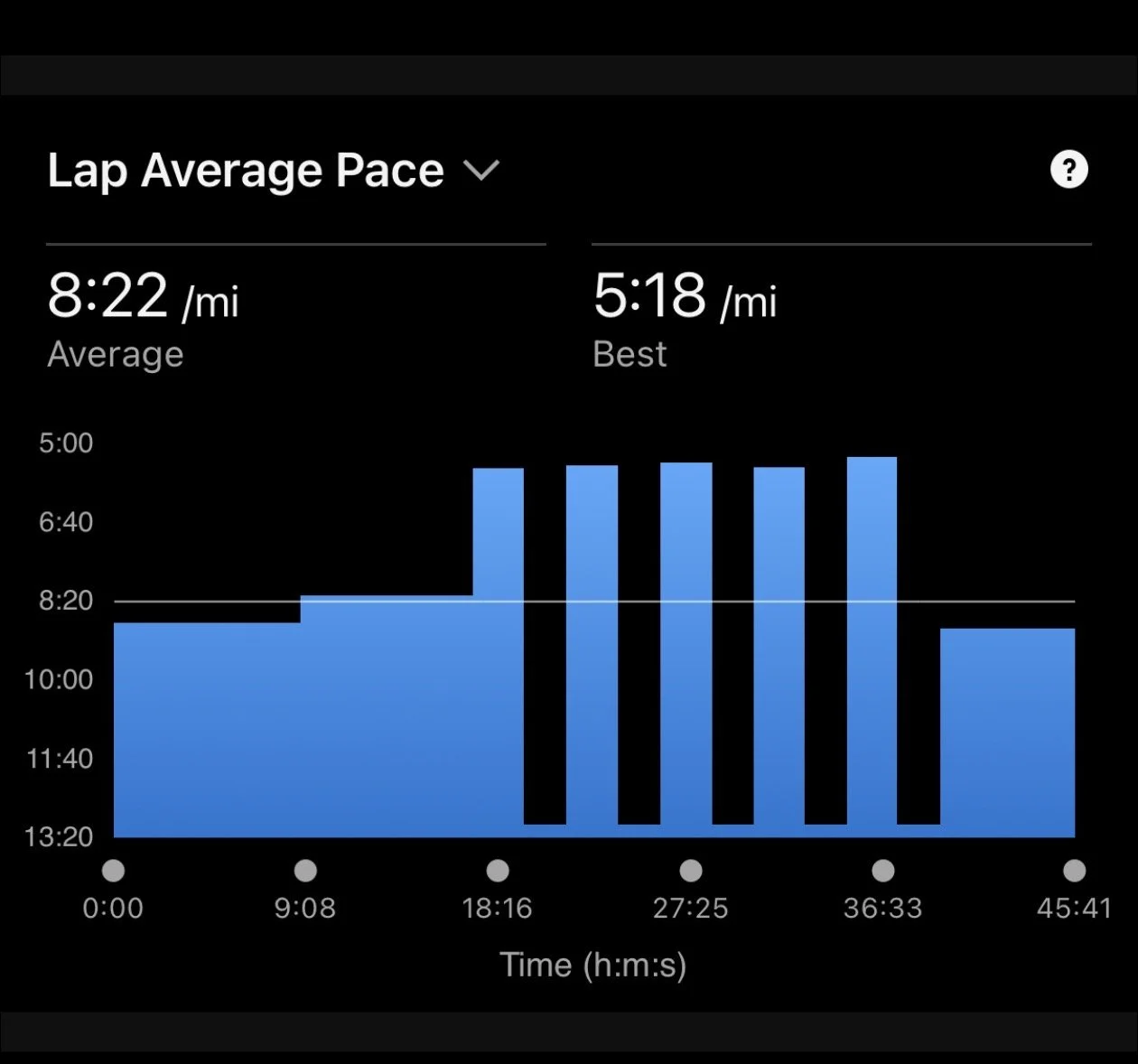
Running Pace Variability refers to the extent that a runner’s pace can change. For example, a runner who jogs at 10:30/mile pace and sprints at 4:00/mile pace has a fairly large range in paces they can access: a high pace variability. (See photo for an example of high pace variability.) A runner who jogs at 9:00/mile pace and sprints at 7:00/mile pace has very little pace variability.
Quite simply, you can’t get faster if you don’t run fast. And you can’t run fast if you don’t run slow. You also can’t run fast if you only have 1 gear.
When I start working with a runner, one of the first things I look for is pace variability.
Does the runner always run at approximately the same pace?
Does their pace change significantly in shorter runs vs in longer runs?
Does the runner do interval workouts and if so, how do their intervals paces compare to their warmup jog pace?
Many runners do not vary their pace significantly and changing this becomes my top priority as a coach. I immediately give assignments with run paces slightly slower and slightly faster than the person’s go-to pace. Increasing running pace variability should be done gradually and with care, as running too fast and too much is a sure way to get injured.
Get Comfortable (Run Slower)
For runners who are stuck in a narrow pace range (low pace variability), there is no hard or easy pace. There is no fast and slow. It’s all the same. Moderate.
This can lead to runners doing their warmup too fast and then hitting paces that are hardly any faster in the intervals. This is ineffective training.
In order for running to feel truly easy, a runner will need to slow down. I ask runners to complete a training run “feeling like you didn’t really do anything.” You should not feel tired at the end. If this is impossible, I would shorten the outing and add walk breaks. Sometimes it helps to try nasal breathing for the first 1-2 minutes of a run to establish a pace that is not at all challenging.
Get Uncomfortable (Run Faster)
The safest way to start working on fast speeds is with very short pace pickups or Strides (10-20seconds of running).
The goal is to introduce a new pace that is basically never touched in the regular training routine. This is done in very short, small doses in order to lower injury risk.
Strides should be run at a pace that is just one gear or even half a gear faster than someone’s typical fastest pace. For someone who does not run workouts, only steady runs, always at pace of ~10:00/mile, strides should be slightly faster than that. For someone who runs tempo workouts or mile repeats but nothing more intense than that, the strides pace should be slightly faster than tempo run pace.
Run strides 1-2 times per week after an easy run when the body is already warm and loose. Over time (many weeks) a runner will be able to run strides faster and faster. The ultimate goal is to condition the body so it can comfortably and safely sprint for 10-20 seconds. It could take a runner months to achieve this depending on their starting point.
As a runner pushes their top speed faster, it makes all paces slower than the top speed feel just a little bit more comfortable in comparison.
Read More:
Use the Cycle Run workout to practice different speeds
More info on Running Strides
Speedwork 101: Run Faster So You Can Run Faster
Nicole Sifuentes is a full-time Running Coach for adults of all ages and abilities. She is a former professional runner and 2-time Olympian, and Certified Strength and Conditioning Specialist. Read more about her services, and schedule your free coaching consultation.
100% Individualized Coaching.
Discover Your Potential. Inquire now!